


Choosing a Whole-Home Humidifier for a Dry Home
Dry air, static shocks, and cracked hardwood? Learn how whole-home humidifiers work, how AprilAire bypass, fan-powered, and steam models compare, and the checks Markham Heating and Air Conditioning completes to size the right one for your home.
Summarize or Share at:
If your home feels dry every winter, you’re not imagining it.
When cold outdoor air comes inside and gets heated, its relative humidity drops sharply. The result can be dry skin, static shocks, scratchy throats, and gaps in your hardwood floors.
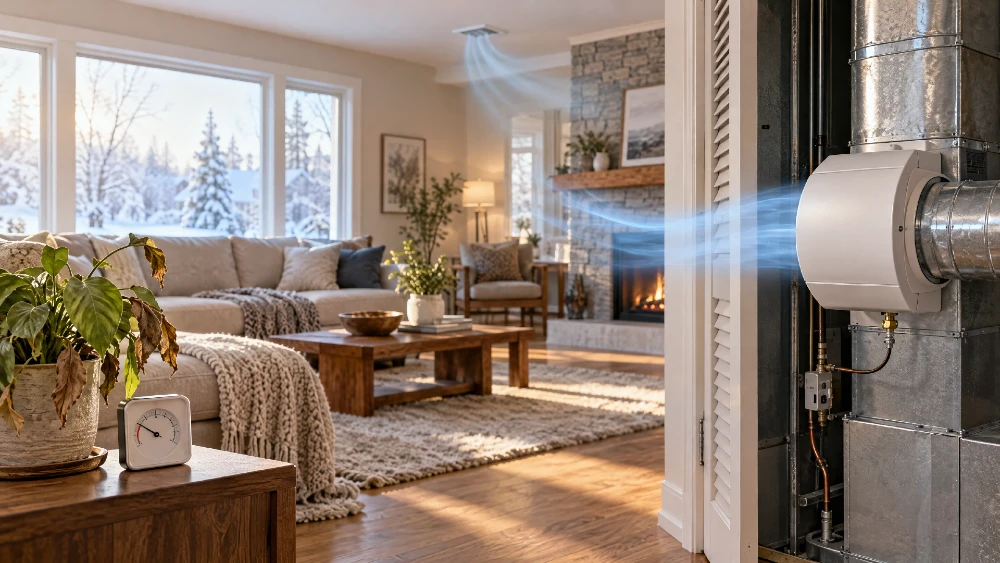
A whole-home humidifier adds moisture back through your ductwork, so every room benefits. Here’s how the different types compare and how we choose the right one for your home.
Why does my home feel so dry in winter?
Cold air holds very little moisture. When that air leaks into your home and warms up, its relative humidity drops. On a cold January day, indoor humidity can fall well below comfortable levels.
Older homes with more air leaks tend to feel drier, because they bring in more cold, dry outdoor air. Newer, tighter homes hold onto moisture better, but they can still dry out during long cold stretches.
What are the benefits of a whole-home humidifier?
A properly sized and controlled humidifier can help:
- Reduce dry, itchy skin and static shocks
- Ease the dry feeling in your nose and throat
- Protect hardwood floors, trim, furniture, and musical instruments from drying and cracking
- Make your home feel warmer at the same thermostat setting
- Replace portable humidifiers that need daily refilling and cleaning
A whole-home humidifier connects to your water line and works through your heating system, so there’s nothing to refill.
Types of whole-home humidifiers
There are three main types. They differ in how they add moisture, how much they can deliver, and what they cost to install and run.
Bypass humidifiers A bypass humidifier mounts on your ductwork and uses your furnace blower to push warm air through a water-soaked pad, called a water panel. A small bypass duct connects the supply and return sides so air can flow through the unit.
- Simple design with few moving parts
- Usually the most affordable to buy and install
- Only adds moisture when the furnace blower is running
- Needs room on the ductwork for the unit and bypass duct
Fan-powered humidifiers: A fan-powered humidifier works like a bypass unit but has its own built-in fan, so no bypass duct is needed.
- Slightly higher output than a comparable bypass unit
- Good fit when there isn’t room for a bypass duct
- Costs a bit more than a bypass model
- Needs a 120V power connection
Steam humidifiers: A steam humidifier boils water electrically and injects steam directly into your ductwork. Because it makes its own heat, it delivers moisture on demand rather than relying on warm furnace air to evaporate it.
- Highest output and most precise humidity control
- Most effective option for reaching and holding your target humidity
- Highest up front cost, and usually needs a dedicated electrical circuit
- Uses electricity to make steam, so running costs are higher
AprilAire humidifiers we install
We install AprilAire whole-home humidifiers. Here are the main models we offer.
AprilAire 500: Small bypass. A compact bypass model rated at 12 gallons per day. A good budget option for smaller homes.
AprilAire 600: Large bypass. Our most popular all-around choice for typical homes. Rated at 17 gallons per day, with automatic digital control available.
AprilAire 400: Water-saving bypass. Rated at 17 gallons per day, like the 600, but designed to use all the water that enters it instead of sending extra to the drain. A good option when a floor drain is far away or water use is a concern.
AprilAire 700: Fan-powered, rated at 18 gallons per day. Its built-in fan means no bypass duct, which helps in tight mechanical rooms and with variable-speed furnaces.
AprilAire 800: Steam. The highest output in the lineup, up to about 23 gallons per day at 240V. Steam goes straight into the airstream, so moisture reaches your home quickly and consistently. Best for larger homes and homeowners who want maximum effectiveness and tight humidity control.
All models come in manual (“M”) or automatic versions. More on that below.
Humidifier sizing chart
This chart is a rough guide only. Every home is different, and we confirm sizing with an in-home assessment before recommending a model.
| AprilAire model | Type | Capacity (gallons/day) | Tight home | Average home | Older or drafty home | Relative up-front cost |
|---|---|---|---|---|---|---|
| Model 500 | Small bypass | 12 | Up to ~3,600 sq ft | Up to ~1,800 sq ft | Up to ~1,200 sq ft | $ |
| Model 600 | Large bypass | 17 | Up to ~5,000 sq ft | Up to ~2,500 sq ft | Up to ~1,700 sq ft | $$ |
| Model 400 | Water-saving bypass | 17 | Up to ~5,000 sq ft | Up to ~2,500 sq ft | Up to ~1,700 sq ft | $$ |
| Model 700 | Fan-powered | 18 | Up to ~5,300 sq ft | Up to ~2,700 sq ft | Up to ~1,800 sq ft | $$$ |
| Model 800 | Steam | Up to ~23 (240V) | Up to ~6,200 sq ft | Up to ~3,100 sq ft | Up to ~2,100 sq ft | $$$$ |
How to read this chart:
- Tight home: Newer construction with good insulation, sealed windows and doors, and few drafts.
- Average home: Moderate insulation and some air leakage. Most homes built in the 1980s and 1990s fall here.
- Older or drafty home: Older windows, less insulation, and noticeable drafts.
Tight home figures come from AprilAire’s published ratings. Average and older home figures are rough estimates based on the AHRI Guideline F sizing method used in AprilAire’s specification sheets, where an average home needs about twice the moisture of a tight home and a loose home about three times as much. Ratings assume the furnace blower is running, warm furnace air, and 8-foot ceilings. Actual performance will vary.
How we size your humidifier
Square footage alone doesn’t tell the whole story. Before recommending a humidifier, we look at:
- Home size and ceiling height. The total volume of air that needs moisture, not just the floor area.
- How tight your home is. Insulation, window and door condition, the age of the home, and signs of drafts. A drafty home can need two to three times as much moisture as a tight one of the same size.
- Your heating system. Evaporative models depend on warm air from your furnace to work well. The type of system and the air temperature it delivers help us decide between evaporative and steam.
- Blower operation. Bypass units only work when the blower runs. With a variable-speed furnace or short heating cycles, a fan-powered or steam model may make more sense.
- Ductwork layout. We check the supply and return plenums for room to mount the unit and run a bypass duct, and look at how your duct runs carry air through the home.
- Water supply and drain. We confirm there’s a water line nearby and a drain for models that need one.
- Electrical. Steam models usually need a dedicated circuit, and fan-powered models need a 120V connection.
- Water quality. Hard water affects how often water panels or steam canisters need replacing.
Manual vs automatic controls
Manual controls (“M” models) You set the target humidity on a dial. You’ll need to turn it down as outdoor temperatures drop to avoid condensation on your windows, and back up when it warms up.
Automatic controls An automatic digital control uses an outdoor temperature sensor to adjust indoor humidity for you. As it gets colder outside, it lowers the target to help prevent window condensation, then raises it again as temperatures rise. Many can also turn on the furnace fan when moisture is needed.
Automatic control costs a little more, but it’s a set-it-and-forget-it option that keeps humidity in a comfortable, safe range all winter. For most homeowners, we recommend it.
More isn’t always better. Humidity set too high can cause window condensation and, over time, moisture problems in walls and around window frames. That’s why proper control matters as much as the humidifier itself.
Maintenance and running costs
| Type | Regular maintenance | Running costs | Relative up-front cost |
|---|---|---|---|
| Bypass (500, 600) | Replace the water panel at least once a heating season, more often with hard water | Low. Uses furnace heat. Some water goes to the drain while running | Lowest |
| Water-saving bypass (400) | Replace both water panels per AprilAire’s schedule | Low. Uses all the water it takes in, so none goes to the drain | Moderate |
| Fan-powered (700) | Replace the water panel once a season | Low. Small amount of electricity for the fan. Some water goes to the drain | Moderate to higher |
| Steam (800) | Replace the steam canister periodically, depending on water hardness and run time | Highest. Uses electricity to boil water | Highest |
All humidifiers benefit from a yearly check at the start of the heating season. We inspect the unit, replace the water panel or canister as needed, check the water supply and drain, and confirm the control is working properly. Water panel replacement can be included in your annual maintenance visit.
Which humidifier is right for you?
A bypass model (500, 600, or 400) may be a good fit if:
- You have a gas furnace
- Your home is small to medium sized, or reasonably well sealed
- There’s room on your ductwork for a bypass duct
- You want the most affordable option
A fan-powered model (700) may be a good fit if:
- There isn’t room for a bypass duct
- You want a little more output than a bypass unit
- You have a variable-speed furnace
A steam model (800) may be a good fit if:
- Your home is large, or older and drafty
- You want the fastest, most consistent moisture delivery
- You want the most precise humidity control
- You’re comfortable with higher up front and running costs
We’ll recommend the model that fits your home, not the most expensive one.
Book a humidifier installation
Ready to say goodbye to dry winter air? Our technicians serve Markham, Richmond Hill, Stouffville, Unionville, Thornhill, and surrounding communities. We’ll assess your home, heating system, and ductwork, and recommend the right AprilAire humidifier for your needs.